
Welcome to The Decoding Dal Series, a deep dive into the heart of the Indian pantry.
Aligned with Pure Curry’s philosophy of Learn. Create. Savor., this three-part series explores the science and soul of lentils, beans, and pulses. Whether you are confused by the grocery aisle or struggling to get the perfect texture, we are breaking it down step-by-step:
Part 1 (Learn) – Types of Indian Lentils Explained: Names, Families, and Processing.
Part 2 (Create) – How to Cook Dal Properly: The physics and chemistry of soaking, salt, and heat for the perfect cook.
Part 3 (Savor) – Tadka Explained: The alchemy of flavor, exploring Tadka, the Maillard Reaction, and smoking techniques.
If you have ever stood in the aisle of an Indian grocery store staring at twenty different bags of yellow and green seeds, feeling completely lost—you are not alone.
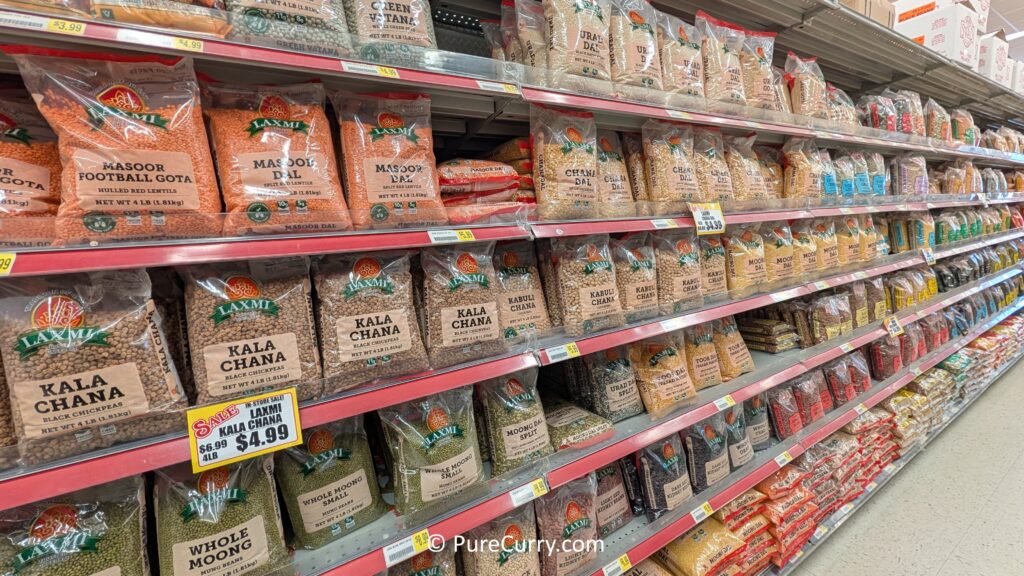
In English, we have specific words: a lentil is different from a bean, which is different from a pea. But in Indian cooking, we often group them all under one massive umbrella: Dal. The word Dal refers to three things simultaneously: the raw ingredient, the cooked dish, and the specific family of legumes used.
In this post, we are going to Learn the fundamental differences between these ingredients and the mechanical process that transforms a hard, whole bean into a quick-cooking lentil.
The Basics: Beans vs. Lentils vs. Pulses
Before getting into Indian names, it helps to understand how these terms fit together. They’re not all on the same level—some are broad botanical categories, others are more specific or regional.
Understanding this hierarchy makes Indian food terminology much easier: many dals are not lentils at all, but split beans or grams that fall under the broader category of pulses.
The Big Picture
Legumes
Legumes are the broad plant family. Any plant that produces seeds in a pod belongs here. Beans, lentils, peas, peanuts, and even soybeans are all legumes. Pulses are just one way we use legumes; other legumes are eaten fresh as vegetables (green beans, peas), grown for oil (soybeans, peanuts), used as animal feed (alfalfa, clover), or planted to improve soil through nitrogen fixation (cover crops like vetch).
Pulses
Pulses are a subset of legumes: specifically, the dried edible seeds of legume plants. Pulses only refers to the dried form, meaning that fresh green beans or peas don’t count as pulses, but dried beans, lentils, and chickpeas do.
All pulses are legumes, but not all legumes are pulses. And pulses only refers to the dried form.
Getting Specific
Legumes are the broad plant family, pulses are the dried seeds we eat, and those pulses show up as dried beans (many of which are called grams in Indian cuisine), lentils, and dried peas.
Beans
Beans are generally larger, kidney- or oval-shaped seeds, such as kidney beans, black beans, or black-eyed peas. They tend to hold their shape well when cooked and are often used whole.
Lentils
Lentils are more specific than beans. All true lentils come from a single species: Lens culinaris. They are small, lens-shaped (biconvex), cook relatively quickly, and are biologically distinct from beans—even though they’re often grouped together in everyday language.
All common edible lentils—brown, green, red, yellow, and black (beluga)—are varieties of Lens culinaris. They differ in color, size, and whether the seed coat is intact, but not in species. In Indian cuisine, the most common true lentil is masoor.
Grams (Indian usage)
In Indian cooking, the word “gram” is commonly used for certain small beans native to the subcontinent. Examples include Bengal gram (black chickpeas) and Green gram (mung beans). Botanically, these are beans, but culturally and culinarily, they’re referred to as grams.
Indian cooks classify dals by how they cook, not by botanical labels. Split moong dal and red lentils (masoor) both hydrate quickly and soften rapidly under heat, so they’re often used in similar dishes—even though they come from different plants and produce slightly different textures.
The Lifecycle: How a Bean Becomes a Dal
One of the most confusing aspects of Indian ingredients is that a single plant can produce three distinct products. You might see three different bags that look nothing alike, but they are actually the exact same seed processed to different extents. Understanding this process helps you predict how the ingredient will cook.
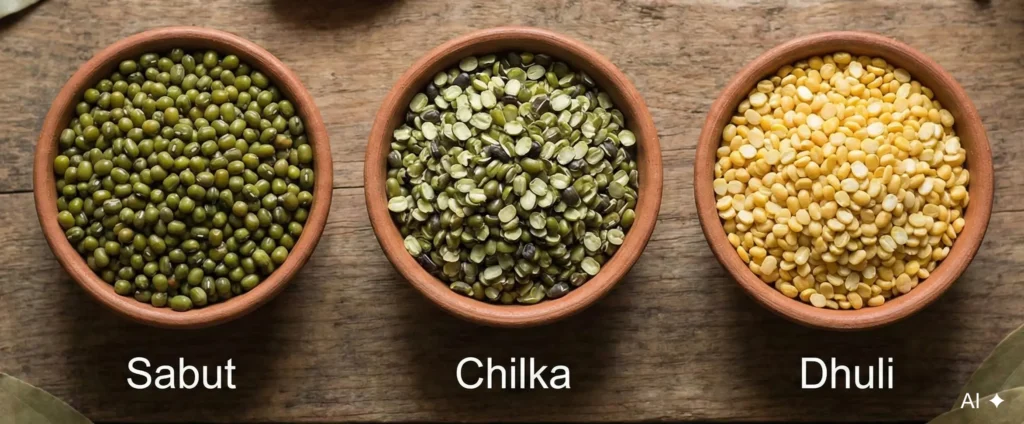
Stage 1 of Processing: Whole (Hindi: Sabut)
This is the seed exactly as it comes out of the pod. It is round and covered in a protective skin (seed coat).
Characteristics: High in fiber, earthy flavor, chewy texture.
Cooking: Requires the longest cooking time and usually needs soaking.
Example: Whole Mung Bean (Green skin, round).
Stage 2: Split (Hindi: Chilka)
The whole seeds are sent through a mill where mechanical friction splits them into two halves (cotyledons). At this stage, the skin is left on.
Characteristics: These offer a middle ground. They cook faster than whole beans because water can enter the split side, but they retain the earthy flavor and fiber of the skin.
Example: Split Green Mung (Yellow interior, green edges).
Stage 3: Skinned & Washed (Hindi: Dhuli)
After splitting, the seeds go through a polishing process (de-hulling) to remove the outer skin entirely.
Characteristics: Without the fiber of the skin, these are pure starch and protein. They don’t hold their shape; they disintegrate into a creamy porridge when cooked.
Cooking: extremely fast; no soaking required.
Example: Yellow Mung Dal (Tiny, yellow, oval).
The Master List
Now that you understand the process, here is the guide to identify the most commonly used dals in everyday Indian cooking.
💡Use this table as a cooking guide, not just a reference. Each family groups dals that behave similarly when cooked, which means they follow the same basic steps for soaking, cooking, and finishing. Once you learn the method for one dal in a family, you can apply it confidently to the others.
The Mung Family
| Name | Visual | Best Uses |
| Whole Green Gram (Moong Sabut) | Small, oval, dark green skin. | Sprouting, salads, wholesome stews. |
| Split Green Gram (Moong Chilka) | Split yellow interior with green edges. | Lighter dals, easy digestion. |
| Yellow Petite Lentil (Moong Dhuli) | Tiny, yellow, oval/flat. | Khichdi, smooth dals, desserts (Halwa). |
The Moth Family
Moth bean is closely related to moong, but Indian cooks treat it as a distinct ingredient because it cooks more slowly and is used in heartier, drier preparations.
| Name | Visual | Best Uses |
| Whole Moth Bean (Moth/Matki) | Small, brown, angular; tougher skin than moong. | Sprouting, dry sabzis, rustic dals (especially Rajasthani & Gujarati). |
The Lentil Family
Whole masoor needs longer cooking and retains texture, while split red masoor cooks fast and becomes smooth, but both are used similarly in soups and dals.
| Name | Visual | Best Uses |
| Brown Lentil (Sabut Masoor) | Brown/Gray skin, orange interior. | Hearty stews, soups. |
| Split Red Lentil (Masoor Dal) | Bright orange/red, flat. | Quick weeknight dals, thickening soups. |
The Black Gram Family
| Name | Visual | Best Uses |
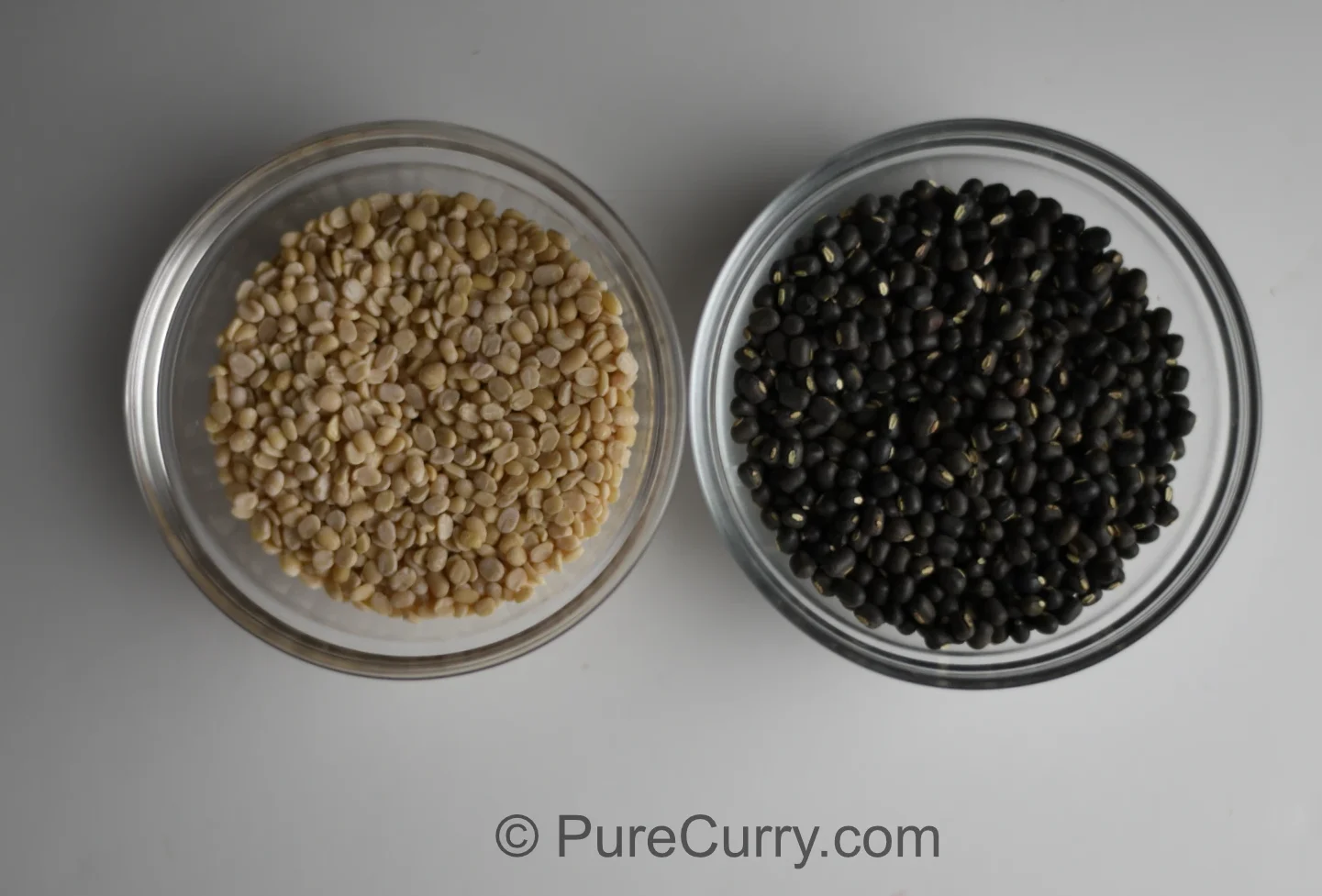
| Whole Black Gram (Urad Sabut) | Small, black, oval. Sticky texture. | Dal Makhani (The rich, creamy classic). |
| Split Black Gram (Urad Chilka) | White interior with black specs. | Dals requiring texture. |
| Skinned White Lentil (Urad Dhuli) | White, slippery when wet. | Dosa/Idli batter, tempering (tadka). |
The Chickpea Family
| Name | Visual | Best Uses |
| Garbanzo/Chickpea (Kabuli Chana) | Large, beige, bumpy. | Chana Masala, Hummus. |
| Black Chickpea (Kala Chana) | Smaller, dark brown/black skin. | Curries, sprouted salads. |
| Split Bengal Gram (Chana Dal) | Looks like Yellow Split Peas but dimpled. | Dal, thick stews, sweet fillings. |
The Kidney Family
| Name | Visual | Best Uses |
| Red Kidney Bean (Rajma) | Kidney shaped, dark red. | Rajma Masala (Curry). |
| Black-Eyed Pea (Lobia) | Cream color with a black “eye.” | Lighter curries, salads. |
The Pigeon Pea Family
Although pigeon pea looks similar to other yellow dals, Indian cooks use it in a very specific way. It is almost always cooked until completely soft and broken down, then finished as a pourable, everyday dal or as the base for dishes like sambar.
Because its texture, cooking method, and role in daily meals are so distinct, pigeon pea is treated as a category of its own rather than grouped with other yellow dals.
| Name | Visual | Best Uses |
| Split Pigeon Pea (Toor/Arhar) | Beige-yellow, flat, and smooth. Less bright and “wrinkled” than Chana Dal. | Sambar, rasam-style dals (thin, tangy), and everyday poured dal. |
Now that you know how to identify dals in the grocery aisle, the next challenge is cooking the different types of lentils. There is a different technique involved with cooking each type of lentil to ensure that you do not end up with mushy or rock hard lentils.
In Part 2: How to Cook Dal Properly, we explore the physics of soaking, the chemistry of salt, and the one mistake that ruins texture every time. Read on to find out…
Leave a Reply